For general enquiries please contact us on
+44 1223 248888
enquiries2026@innoviatech.com
St Andrew's House, St Andrew's Road
Cambridge CB4 1DL United Kingdom
FIND US


For general enquiries please contact us on
+44 1223 248888
enquiries2026@innoviatech.com
St Andrew's House, St Andrew's Road
Cambridge CB4 1DL United Kingdom
FIND US
Technology is changing. Innovation isn’t...
From steam to electricity to mobile phones, every so often a new game-changing technology appears and disrupts how we live and work. Generative AI is the latest in a long line of technology developments, and we’re collectively figuring out how to best use it.
For Innovia, change in innovation is nothing new. Digital solutions have evolved massively over the last 25 years and so have our capabilities. As a business, we’re finding that selective use of AI, coupled with the right guardrails, can enable our teams to innovate better or more quickly to make innovation breakthroughs happen.
How? Well, twenty-five years ago, demonstrating what impaired vision feels like required painstakingly editing images.
Today, the same underlying thinking can render that experience on a smartphone, in real time.
Sure, the output looks different.
But the first-principles thinking behind it hasn’t changed at all.
Here are five examples of our teams applying that same approach of working – understanding, exploring, and deciding – to different innovation challenges, with AI being used selectively to help us get to better outcomes faster than ever before.

Physical products are increasingly supported by digital features, but building and maintaining them well is expensive and easy to get wrong. We’re helping clients identify what their customers genuinely need from digital supplementation, evaluate the right technology to deliver it, and – critically – align that choice with the broader business strategy before a line of code is written. Read more about the work, here: Building the business case for digital innovation.

Medical devices are increasingly customised to the individual patient, accounting for physical fit as well as subjective preference. Simulating those interactions is notoriously challenging: human anatomy and preferences vary widely, and a wrong assumption carries real consequences downstream.
In a recent project, we integrated a newly developed AI algorithm with custom-built code to prototype a device, then tested it in a production environment to confirm it met real patient needs. Read more about how the work is being taken forwards, here: Advancing medical device design through simulation.
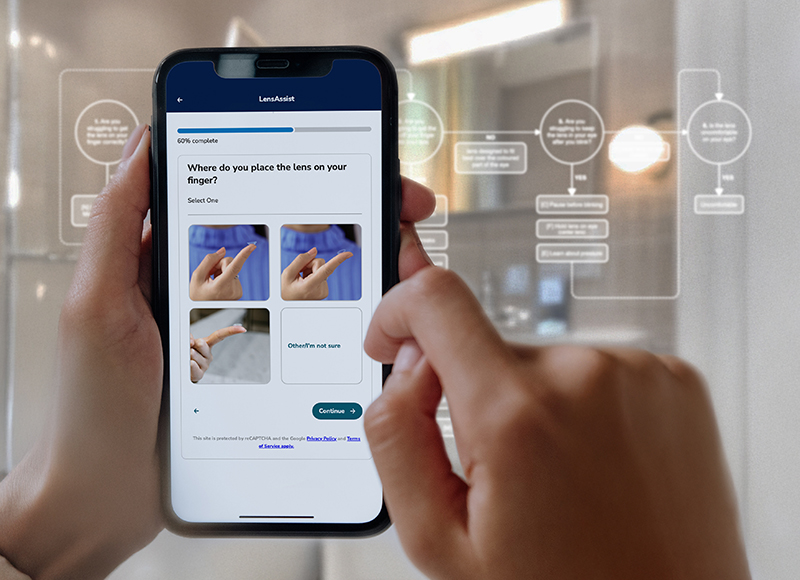
We helped Johnson & Johnson Vision define what a new digital tool would need to do to support contact lens wearers. Working from a detailed understanding of how people actually insert lenses – and where they typically struggle – we created the structure of a troubleshooting algorithm and set the guardrails for its development. The resulting app is now live and reducing the dropout rate for new wearers. Read more about the work, here: Digital troubleshooting for Johnson & Johnson Vision.

Robots have the potential to play an active role in our future. But humans are sceptical about whether they can programme them to do useful work. We helped ABB understand the human experience of training robots and provided insights into perceptions of robot abilities. This work has lowered the barriers that keep otherwise-willing users from adopting a tool at all. Watch a video which describes the work and shares outcomes, here: Helping people to train robots.

Surgical guidance tools are becoming more sophisticated, but choosing the right one – from a fast-growing, fragmented market of digital and AI options – is difficult.
We looked at the relative importance of different types of information and trends, and developed ways to present the filtered and ranked information clearly. We created concepts that worked at different scales – from inventions in haptic and visual communication to broad strategy moves – allowing our client to present the information to surgeons in a way that was complete without being overwhelming. Learn more about the work and outcomes in development, here: Guidance systems for surgeons.
We’ll be sharing our thoughts and developing our thinking further through roundtable conversations at the Innovation Roundtable workshop, at Google London, in early September. If you’re thinking about utilising AI for innovation, value creation and growth and want to be part of the conversation, let’s talk. Email: AI@innoviatech.com.
Patrick is an Innovation Consultant with a background in Chemistry and Synthetic Biology. He specialises in programs that push the boundary of what is both possible and practical, requiring sound holistic technical judgment along with pragmatism on what can realistically be achieved, by facilitating holistic working across sectors from food and beverage to apparel. His favourite programs are the ones where long-standing assumptions can be challenged to find solution spaces that had previously been discounted. Patrick also enjoys working at the intersection of the physical and digital worlds, to keep our clients with the times in the world of AI.

Kathrin is an Innovation Consultant with a background in Soft Matter Physics, and over a decade of consulting experience. She specialises in the front end of R&D, where technical depth has to be paired with big-picture thinking, helping client teams turn complex challenges into practical solutions across sectors from healthcare and food to energy and consumer goods. Her favourite projects are those that don’t come with a set approach — where we have to figure what the core problem actually is, what shape the solution takes and how to get from one to the other. Kathrin is particularly interested in what makes complex systems work better, and the role that technology can play in this. She leads Innovia’s AI team.
Gareth is an Innovation Consultant with a background in Biochemistry, Plant Sciences and Education. He specialises in projects where complex scientific and technical concepts need to be translated into clear, actionable insights for diverse audiences, combining deep scientific expertise with a broad perspective gained from working across disciplines and industries, from food and agriculture to consumer health and FMCG. His favourite projects are those that challenge established thinking and create a shared understanding between technical experts, business leaders and consumers. Gareth particularly enjoys uncovering the stories behind emerging science and technology, helping clients communicate complex ideas with clarity and confidence to enable better decisions and drive meaningful innovation.